

I’m headed to the UNESCO World Heritage Site of Zacatecas. The name comes from the Nahuatl zacatl (zacate/grass) and a locative suffix, roughly “place of grass”—so let’s call it, poetically, “land of grass people.”
Leaving my newly beloved Real de Catorce, I encountered four BMW riders queued for the ride through the Ogarrio Tunnel. They hailed from Mexico City and were heading home—an eight-hour trip if all went well, they said. On their large, accessory‑laden BMW 20-grand-plus luxury coaches, I looked a bit inadequate on my $7,000 KTM. But give me curves, you lawyers on wheels. Kidding, but if there were corners and I was going their way, we’d have to take some curves together...at pace.
Heading back over that wondrous 24km stretch of cobblestones, I decided to up my pace and see what would happen. At 95kph, the ride felt even smoother than my 60kph incoming trip, feeling like I was floating over the stones As I zoomed over the cobbles, a technical miracle happened: my electronic devices began communicating, and I could now get audio directions from Google Maps. Seems the 19th-century cobbles fixed my 21st-century technical issue. More and more, I’m learning to be patient and let solutions come to me—what’s the rush? I sleep better now and have zero worries.
The long run toward Zacatecas unfolds over one of north-central Mexico’s great flat stretches. Here, the Mesa Central—a surprisingly high plateau at 1,800 to 2,000 meters defines the landscape. This is nopal and agave country, dotted with prickly pear, yucca, and mesquite lining the dry waterways. More vegetation than we see in the semi-desert of Guanajuato. These roads are for rolling along at a non-hurried pace. You want this vibe to go on forever. It would make for a serene afterlife b roll.
Along this stretch, I came across a large sign proclaiming “Tropico de Cancer,” with arrows protruding east and west. For those who slept through that class as I did, the Tropic of Cancer is the latitude 23.4° north of the equator, marking the northernmost point on Earth where the sun can be directly overhead at noon around the June solstice. It separates the tropical zone from the northern temperate zone. That was pretty damned cool. Amazing what you find once you leave the couch.
My halfway-there lunch and ass break was at the village of Moctezuma. The settlement dates to around 1552. The original name was Hedionda, but in 1868 it was renamed “Ciudad Moctezuma” to honor General Esteban Moctezuma, who had come from this area. I have learned that several of Moctezuma’s children and grandchildren survived, were baptized, and kept the“Moctezuma name.
But I was there for a taco. More exactly, four of them, quite savory, a Pepsi, and gas.
After Moctezuma, about 50 kilometers out from Zacatecas, the terrain began to roughen and rise. The valleys narrow as you enter an area where the Mesa Central collides with the edge of the Sierra Madre Occidental.
Soon, Zacatecas appears, nestled in a tight valley between ridges at around 2,450 meters—seriously high. The city is essentially built inside the remnants of a collapsed volcanic landscape. We’re off to a good start.
But first, I had to get through the weather. Unlike in a car, riding is a visceral experience that fills your senses. Especially weather. More especially, stormy weather. In the far distance, I could see the telling dark skies and what they would mean for me. It took an hour to ride into this growing darkness and dropping temperature. And when I got to the storm, it turned away. It had just passed through Zacatecas Centro minutes before I arrived. The streets were still streaming with water, but I rolled lucky this time. Yeehaw, welcome to rainy season and exciting riding conditions.
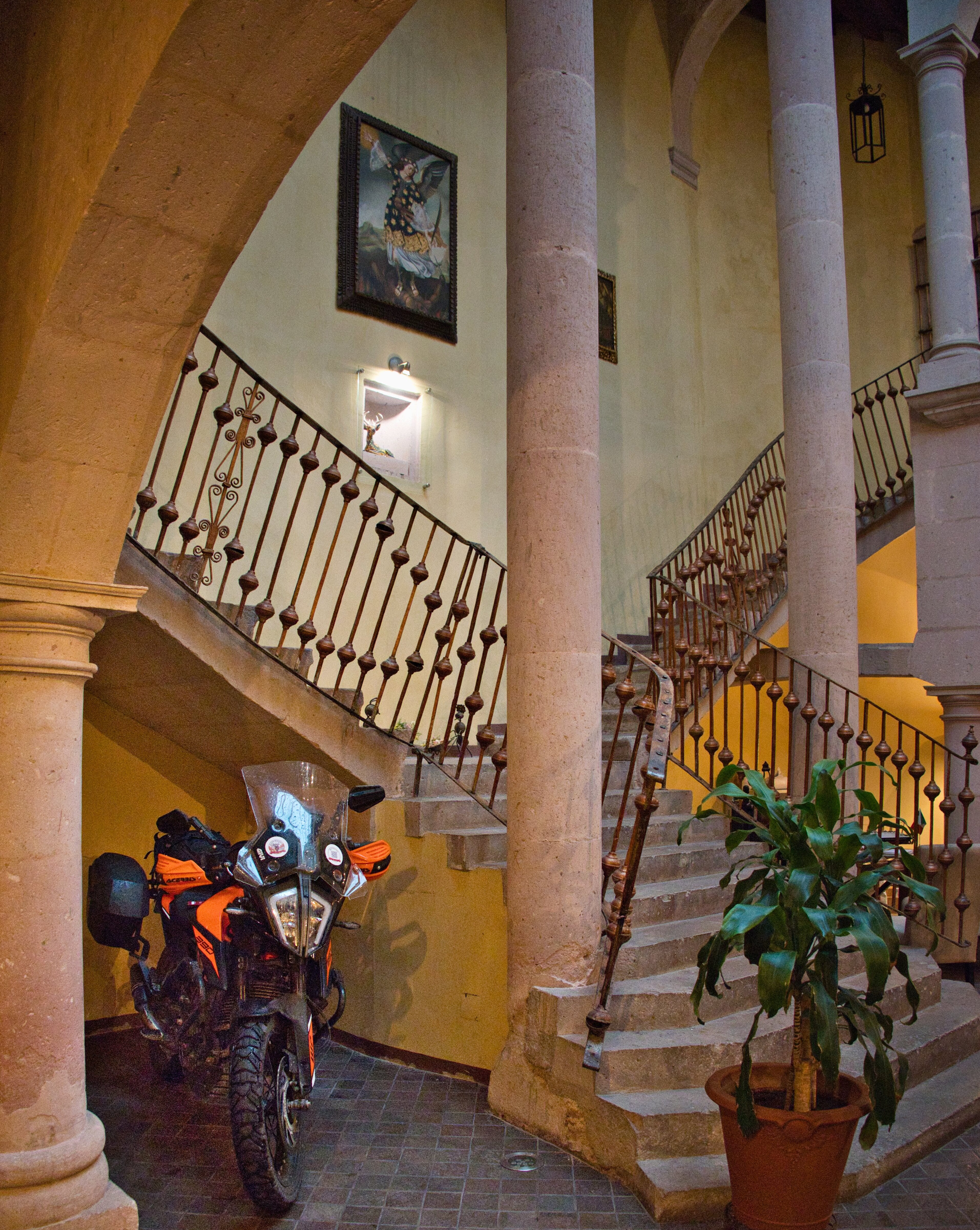
There was still a bit of residual light rain as I rolled up, so I quickly double-parked the bike and ran in to ask where to park. The lady stood up from her desk, walked purposefully to open both front doors, and waved me in. My moto now sits as proud as a lion guarding the grand staircase. That’s honest and true hospitality, not the corporate chocolate-on-a-pillow, turn-down-your-sheets faux posturing at $300+ a night. I leave with a wide smile every time I come and go from the hotel. I’m sure the staff assumes I’m a little cuckooberry. Then again, maybe not. They don’t seem to care about these things.
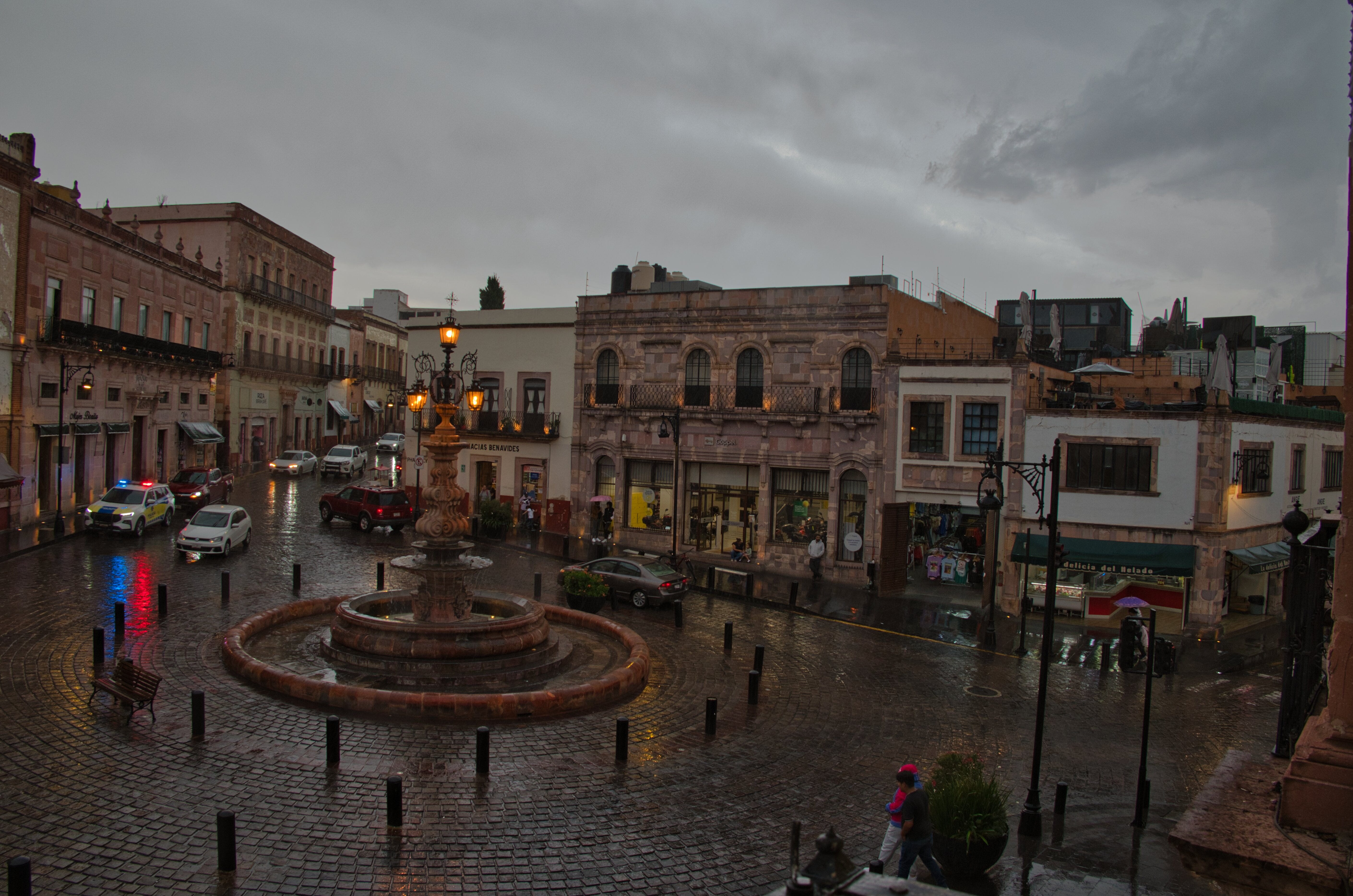
It turns out I’m the only guest at Casa Faroles Hotel, so I got a room with a balcony. The Fuente de los Faroles (fountain) is the architectural focal point right in front of my balcony—and, to my surprise, it’s functional. I am in the very heart of the UNESCO Heritage Site Centro. It’s a special feeling. As night falls, the streets glisten from the recent rain as people queue up at the taco stand.
Daily Expenses: 80 pesos for lunch of four bistek tacos and a Pepsi, 250 pesos for gas, and 70 pesos for a Negro Modelo, jalapeno potato chips, and Golden Nuts (japones). The expense crusher was the room, weighing in at a hefty 1,400 pesos. In Zurich, Switzerland, a 5 km taxi ride is 27–28 USD.
Gringo Count: 0. But an English-speaking Mexican visiting from Cancun did ask me for directions.
Tomorrow, exploration by foot.
Still zero gringos!
Fabulous that you could park inside!